THE LESSON ROOM
The card that finds its way home
Three choices bring a remembered card to a place you can predict. Your first self-working card effect.
WHAT YOUR AUDIENCE SEES
The effect
Someone silently remembers a card. They tell you only which of three columns contains it, three times. You reveal the card.
What you need
- 21 different playing cards
- A clear tabletop
Your practice goal
Find each of three different cards correctly, then repeat once while telling your story.
I’m here to learn. Show me the method.
Method
- Take exactly 21 cards. Deal face up across the table: left, middle, right, then repeat. Make three columns of seven, with every card visible.
- Ask a spectator to remember one card and tell you its column, not its name.
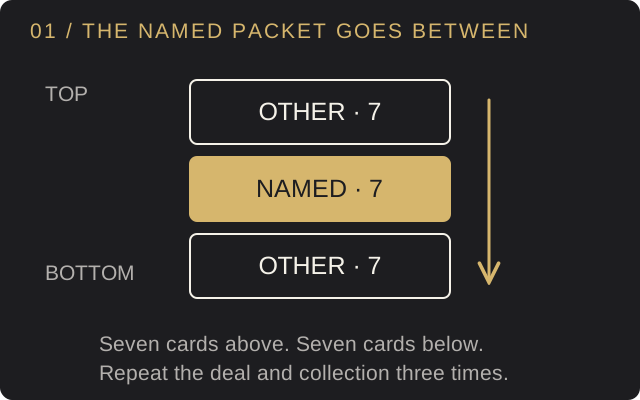
- Collect each column into its own packet, keeping its cards together. Put the named packet between the other two packets. Square everything into one face-down stack.
- Deal across three columns again. Ask for the new column and collect with that packet in the middle.
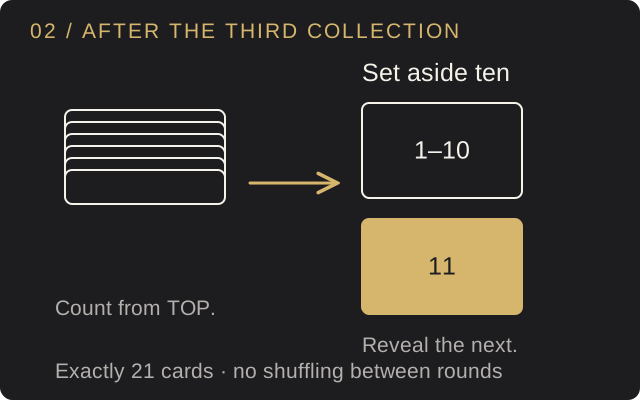
- Repeat once more. After this third collection, the selection is the 11th card from the top. Count off ten cards, then reveal the next.
Do not shuffle between rounds. Collect all seven cards from each column; do not gather by rows. Practice the same gathering action each time.
Performance and patter
Try a story about finding an old friend in a crowd: “You don’t need to tell me their name. Just point me in the right direction.” Let each deal feel like a new chapter. Three rounds can feel long, so keep the conversation light.
Common mistakes
- Using 20 or 22 cards. Count before starting.
- Putting the selected packet on top instead of in the middle.
- Changing the remembered card midway. Ask them to stick with their first choice.
- Counting the 11th card from the wrong end. Begin from the top of the face-down stack.
Why the practice matters
The procedure does the calculation, but you provide the experience. Rehearse a calm reveal, and avoid challenging your spectator to catch you. Try the browser version.
Original teaching and presentation notes for a traditional principle. Historical reference: Professor Hoffmann, Modern Magic (1876).
Share the effect, respect the creator, and let people choose whether to learn. Our code →