THE LESSON ROOM
The sixteen-card crossroads
A remembered row becomes a secret coordinate in this tidy card mystery.
WHAT YOUR AUDIENCE SEES
The effect
A spectator thinks of a card and names its row. After you rearrange the cards, they name its new row. You know the card.
What you need
- 16 different cards
- Space for a four-by-four grid
Your practice goal
Practice all sixteen possible selections without losing track of the original row.
I’m here to learn. Show me the method.
Method
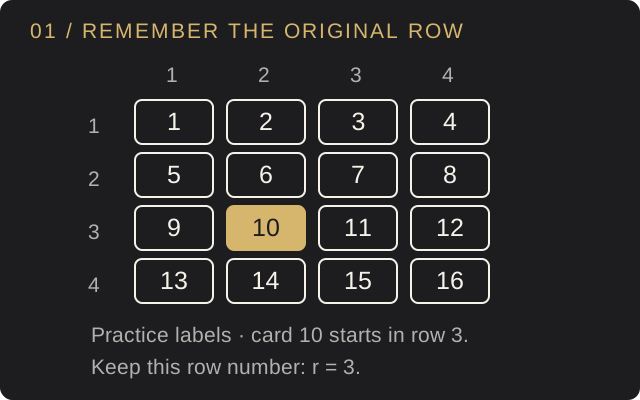
- Deal 16 cards face up into a four-by-four grid, filling the first row left to right, then the next row. Number the rows 1–4 from top to bottom in your mind.
- Ask your spectator to think of one card and tell you which row it is in. Remember that row number, r.
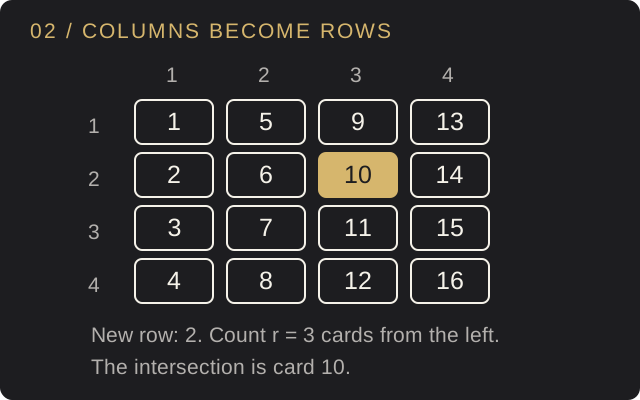
- On a fresh space on the table, make a new grid by taking the original first column from top to bottom and placing those cards as the new first row, left to right. Do the same with original columns two, three, and four to form the remaining rows. Keep both grids oriented toward you.
- Ask which row now contains the selection. In that row, count r cards from the left. That is their card.
You have transposed the grid: the original row number is now the column number. For practice, choose original row 3, column 2. After moving the columns into rows, that card is in row 2, column 3.
Performance and patter
“Imagine four streets. Now we’ll turn the map.” Give each move a reason and keep the cards visible. Treat the spectator’s two answers as directions toward a destination.
Common mistakes
- Using your spectator’s left and your left interchangeably. Keep the layout facing the same way.
- Gathering the cards into a loose pile and losing their order. Use the explicit two-grid method until confident.
- Forgetting the first row number while moving cards. Rehearse with all sixteen positions.
Your next rehearsal
Once the layout is reliable, practice looking at your spectator while asking the questions. A clear procedure leaves room for a friendly performance.
Original teaching and presentation notes for a traditional principle. Historical reference: Professor Hoffmann, Modern Magic (1876).
Share the effect, respect the creator, and let people choose whether to learn. Our code →