THE LESSON ROOM
A coin, a moment, and nothing
Learn the French drop: a traditional false transfer, and a first lesson in where an audience looks.
WHAT YOUR AUDIENCE SEES
The effect
A coin appears to pass from one hand to the other. The receiving hand opens—and the coin is gone.
What you need
- One comfortable-sized coin
- A soft practice surface
Your practice goal
Make ten real transfers and ten false transfers look as similar as possible from the audience’s view.
I’m here to learn. Show me the method.
AT YOUR OWN PACE
Follow the real coin
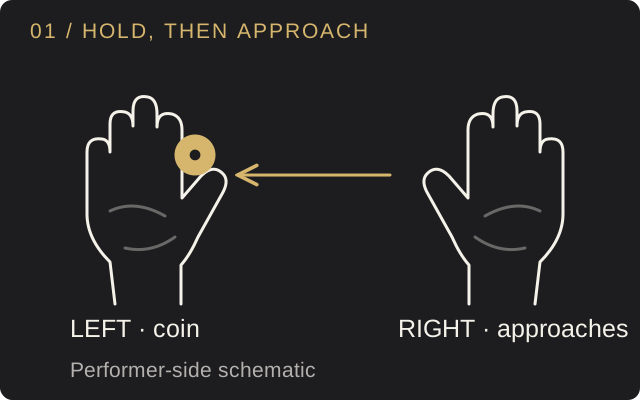
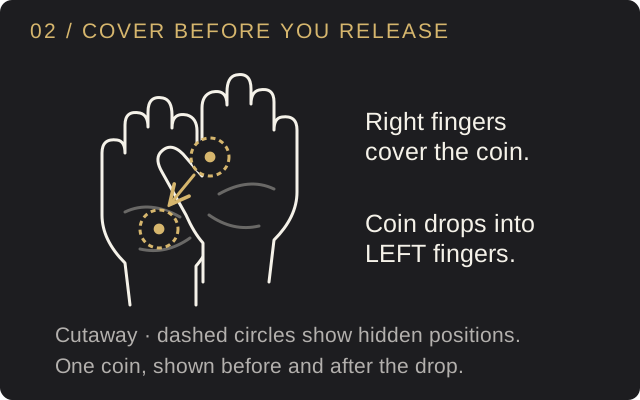
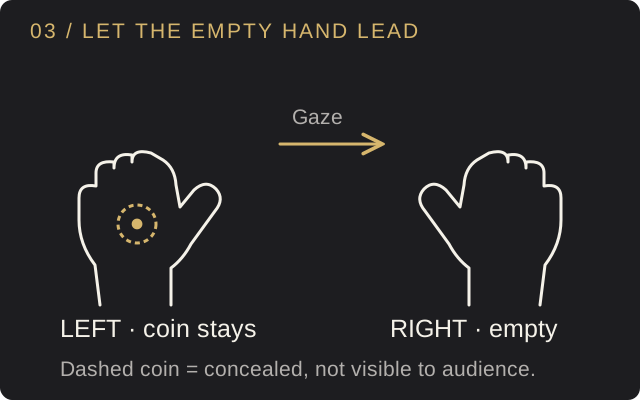
Simplified hand positions, viewed from the performer’s side. Solid gold is visible; a dashed coin is a cutaway showing a concealed location.
Each move plays once and waits. Drag the position slider to examine any moment. The still diagrams and full instructions follow below.
Method
First practice a real transfer. Hold the coin by its edges between the left thumb and fingertips, palm angled upward. Bring the right hand over it, fingers in front of the coin and thumb behind. Take the coin, close the right hand loosely, and move that hand away. Watch where both hands naturally go.
For the false transfer, begin the same way. As the right fingers cover the coin, relax the left thumb so the coin falls into the curled left fingers. The right hand closes as if it took the coin, then travels away empty. The left hand settles naturally, keeping the coin concealed.
Follow the right hand with your eyes. Pause, make a small opening gesture, then slowly open it to show the vanish. The coin is still in the left hand. This is a single-hand vanish, not a claim that both hands are empty.
Performance and patter
“Some things disappear the moment you try to hold on too tightly.” Keep the imagined coin’s location consistent. The empty hand should move as though it really carries something; the other hand should not freeze.
Common mistakes
- Gripping the apparently occupied hand into a strained fist.
- Looking at the hand that still holds the coin.
- Dropping the coin before the taking fingers hide it.
- Exposing the left palm to someone at your side. Rehearse from audience angles.
Finish honestly
Close the routine before resetting out of view. Do not pretend to show the concealed hand empty. This lesson teaches the classic transfer, not a complete professional vanish-and-reproduction routine. Read about attention.
Original teaching and presentation notes for a traditional principle. Historical reference: Professor Hoffmann, Modern Magic (1876).
Share the effect, respect the creator, and let people choose whether to learn. Our code →