THE LESSON ROOM
A familiar face in the crowd
Use a neighboring card to locate a selection, then turn the search into a clear, unhurried revelation.
WHAT YOUR AUDIENCE SEES
The effect
A chosen card is returned and the deck is cut. You find the selection without asking its name.
What you need
- An ordinary deck
- A table with space for a face-up row
Your practice goal
Find ten selections after different complete cuts, including a key card at the bottom, without losing your place.
I’m here to learn. Show me the method.
AT YOUR OWN PACE
See how the key becomes a neighbor
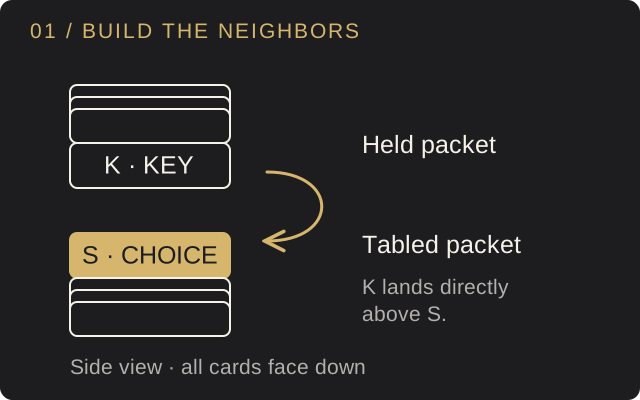
Side-view teaching model. K is the known key, S is the selection. All cards remain face down until the dealing step.
Each move plays once and waits. Drag the position slider to examine any moment. The still diagrams and full instructions follow below.
Before you begin
This principle is simple; the intermediate work is managing the return, keeping a natural pace, and locating a card while still talking to a person. First get comfortable with holding and dealing cards. This handling allows complete cuts, not shuffles.
Method: make a neighbor
- Privately note the bottom card of the face-down deck before you offer a selection. This is your key card. Remember its rank and suit.
- Let someone take a card from the middle, remember it, and show other spectators. Keep the bottom card in place; do not shuffle.
- Cut about half the deck from the top and put that packet on the table. Ask for the selection to be placed face down on top of that tabled packet.
- Put the packet still in your hand on top of everything. Its bottom card—the key—is now immediately above the selection in face-down top-to-bottom order.
- Make one complete cut: lift a top portion and move it below the rest. You may repeat a straight complete cut. Do not mix packets or shuffle.
Find it without reversing the order
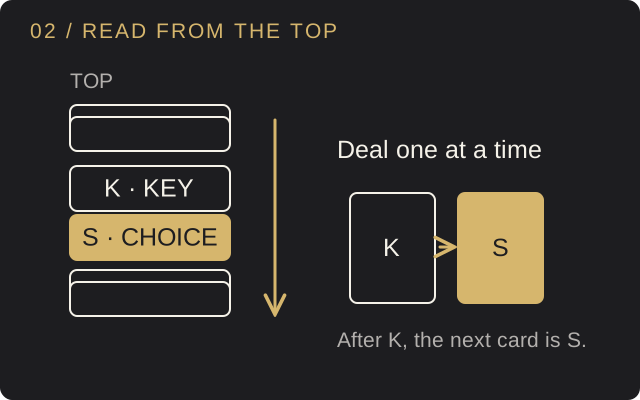
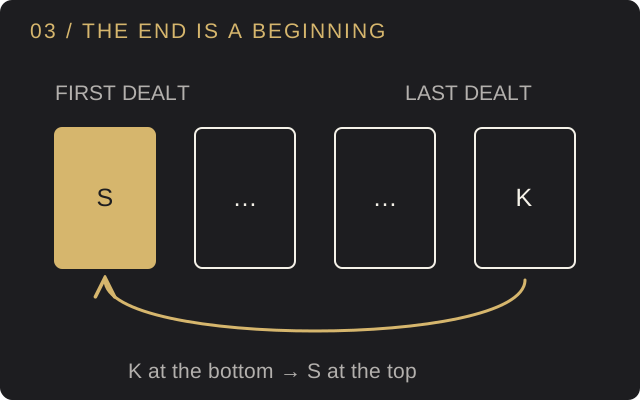
Deal cards from the top face up into a row, one at a time. Watch for the key. The next card dealt is the selection. If the key is the very last card, the selection was the very first card dealt: the pair has wrapped around the ends of the deck. Leave the row visible so you can recover that first card.
In practice, announce the key and selection to yourself. In performance, keep dealing a few more cards after the selection so the stop is not a mechanical signal. Look over the row, then slide the selection forward. Ask its name only after you have committed to one card.
A presentation to make your own
“In a crowd, one familiar face changes everything.” Use one line, not a long story that competes with the instructions. Let the spectator turn over the chosen card or confirm the face-up selection. Do not claim they shuffled; they cut.
Common mistakes and recovery
- A riffle or overhand shuffle can separate the pair. If someone shuffles, accept it and start a different effect or openly begin again. Do not pretend the key still guarantees a location.
- Turning an entire packet face up reverses the reading direction. The dealing procedure above avoids that ambiguity.
- Forgetting the key is not a reason to fish for the spectator’s card. Reset during practice; in performance, acknowledge losing the thread and move on.
Your checkpoint
Use ten different selections and cuts. Include one trial where the key finishes at the bottom. Pass when all ten locations are correct, your instructions need no correction, and you can explain exactly which kinds of mixing would break the method.
Original handling notes and presentation exercise for the traditional key-card principle. Linked teaching provides further instruction.
Share the effect, respect the creator, and let people choose whether to learn. Our code →