THE LESSON ROOM
Gone is only half a story
Complete a French-drop vanish with a motivated return, a relaxed concealed hand, and a clean final picture.
WHAT YOUR AUDIENCE SEES
The effect
A coin apparently vanishes from one hand, then appears again at the other fingertips. Both hands finish openly empty except for the coin.
What you need
- One coin that rests comfortably in curled fingers
- A soft practice surface
- A phone or mirror for checking audience angles
Your practice goal
Perform the transfer, vanish, return, and open finish without freezing the hand that retains the coin.
I’m here to learn. Show me the method.
AT YOUR OWN PACE
Give the vanish a complete ending
Continue from the French drop. The coin stays in the left hand until the final real transfer. Keep the back of that hand toward your audience.
Each move plays once and waits. Drag the position slider to examine any moment. The still diagrams and full instructions follow below.
Start with a reliable transfer
Learn the French drop first. For this lesson, perform seated or standing with a willing spectator directly in front of you. The concealed left palm must not face the audience. This is not an all-angle handling.
Method: keep track of the real coin
The diagrams continue the sequence from the French-drop lesson: the separation, the hidden adjustment, and the return.
Make the French drop as taught: the right hand seems to take the coin, but the coin falls into the curled left fingers. The right hand moves away and apparently holds it. The left hand settles lower, relaxed, with its back toward the audience. Keep both hands in view; do not introduce a pocket or reach behind someone.
Look at the apparently occupied right hand. Let a short beat pass, then slowly open it to show the vanish. Keep the left fingers gently curled. Do not open the left palm while the coin is there, and do not add an exaggerated “empty” gesture.
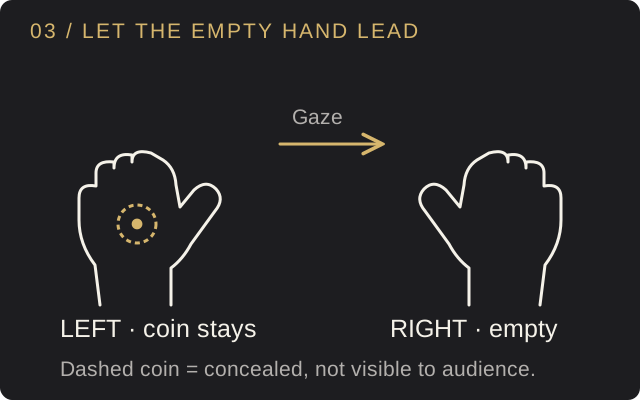
Bring it back deliberately
Look toward a point just above your left hand. Say, “Perhaps it only needed a little room.” With the left hand still back toward the audience, use the left thumb to guide the retained coin up against the inner side of the left index finger. Pinch its edge between the thumb and index fingertip.
Raise the hand a little and extend the coin into view at the fingertips, as though it has arrived at the spot you looked toward. This is a simple production from concealment, not a toss or a difficult palm transfer. If you cannot move the coin securely, practice this adjustment alone over a table before combining it with the vanish.
Let the coin be seen clearly. Now take it for real in the right hand. Open the left hand naturally, then place the coin on the table and relax both hands. That final real transfer gives the routine a definite ending.
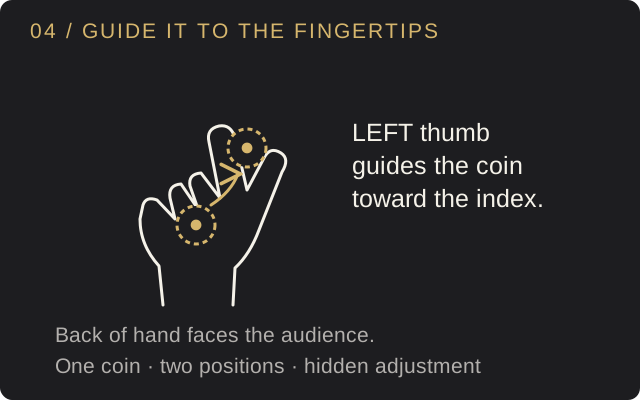
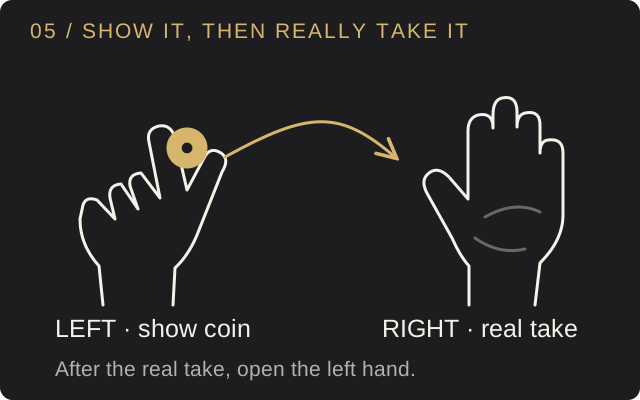
Match the story to the action
Do not call this a journey to a spectator’s pocket or imply the coin crossed the room. The effect is a vanish and a return at your own fingertips. One suggested line is enough; replace it with language you would actually say.
Common mistakes and a rehearsal drill
- Moving the retained coin while the audience is still studying the left hand.
- Letting a metallic click announce the adjustment. Relax the grip and avoid jewelry contacting the coin.
- Reaching near a spectator’s face without asking. This routine needs no contact.
- Ending with the left hand closed, inviting suspicion after the magic is over.
Record three runs from directly in front, then inspect the edges of your intended viewing area. Rehearse the return alone ten times, the vanish alone ten times, then five complete sequences. Pass when the coin stays secure, neither hand freezes, and the ending leaves no hidden object to dispose of.
Original short sequence and rehearsal notes using the traditional French drop and fingertip production; historical context in Hoffmann’s Modern Magic.
Share the effect, respect the creator, and let people choose whether to learn. Our code →